
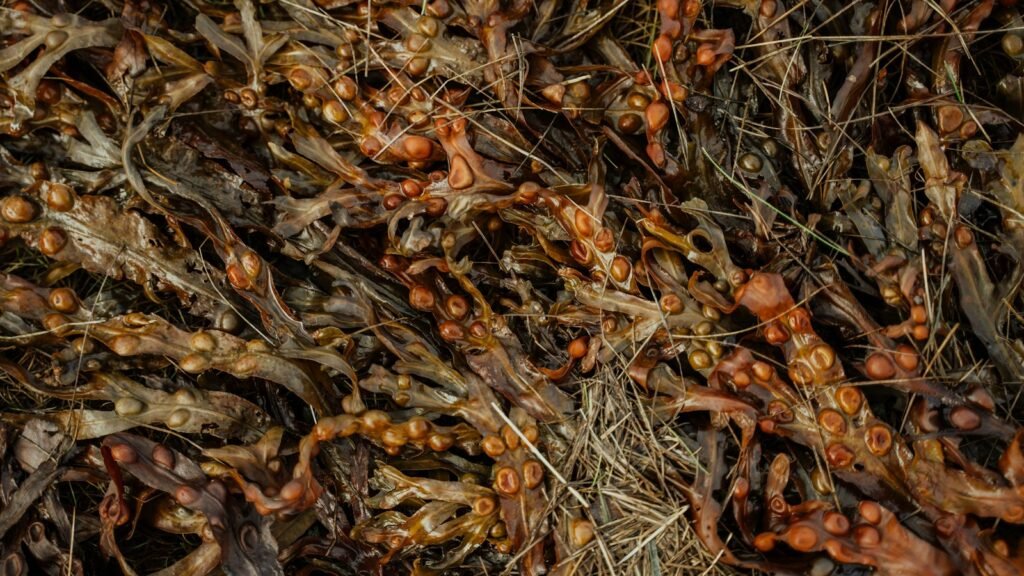
Indonesia’s seaweed trade is dominated by red seaweeds: cottonii and spinosum for carrageenan, Gracilaria for agar. Alginate, the third major seaweed hydrocolloid, comes from a different group altogether — the brown seaweeds. In Indonesian waters the most common of these is Sargassum, which grows wild on reefs and rocky shores rather than on farms. Understanding that difference explains most of the quality questions buyers ask about it.
What alginate is
Alginate is a polysaccharide found in the cell walls of brown seaweeds, where it gives the plants flexibility and strength. Extracted and purified, usually as a salt, it dissolves in water to form viscous solutions. Its best-known property is that it gels when it meets calcium ions, without needing heat. Chemically, alginate is a chain built from two sugar acids, mannuronic and guluronic acid. The proportion and arrangement of the two vary between species and even between parts of the same plant, and they matter: alginates rich in guluronic acid tend to form stronger, more brittle calcium gels, while those rich in mannuronic acid give softer, more elastic ones. That reaction with calcium is what makes alginate useful for restructured foods, spherified drinks, wound dressings, dental impression materials and peel-off cosmetic masks.
It sits alongside the other two seaweed hydrocolloids rather than replacing them. For a side-by-side view of red-seaweed products, see our comparison of carrageenan and agar, and for the carrageenan types themselves our guide to kappa, iota and lambda.
The alginate family of additives
In food labelling, alginic acid and its salts and ester carry their own E-numbers:
- E400 — alginic acid.
- E401 — sodium alginate, the most widely used form.
- E402 — potassium alginate.
- E403 — ammonium alginate.
- E404 — calcium alginate.
- E405 — propylene glycol alginate (PGA), valued for its stability in acidic products and for foam stabilisation.
Outside food, the same materials appear in pharmaceuticals, textile printing and cosmetics; our article on seaweed in cosmetics covers the personal-care side.
Sargassum: a wild resource
Much of the world’s alginate has historically come from large cold-water brown seaweeds such as kelps. Sargassum is a tropical and subtropical alternative. In Indonesia it is gathered from the wild by coastal communities, either cut from the shore at low tide or collected when it washes up, then dried in the sun.
Being wild-harvested changes the picture compared with farmed red seaweed. There is no seed stock or planting cycle to manage, but supply depends on natural growth, season and local conditions. Harvesting pressure on reefs and shorelines is also a legitimate environmental concern, and responsible buyers should ask how and where collection happens.
Post-harvest handling matters as much as it does for red seaweeds. Brown seaweed is bulky and holds a lot of water when fresh, so drying it thoroughly and quickly is essential. Material that stays damp can ferment or grow mould, and alginate quality can suffer in storage if the seaweed is not kept dry and protected.
Quality questions buyers ask
Alginate from Sargassum is often regarded as having different, and in many cases lower, viscosity and gel performance than alginate from traditional kelp sources, though results vary between species and studies. That makes raw material assessment important. The usual questions are:
- Which species? “Sargassum” covers many species, and they are hard to tell apart without expertise.
- How fresh was it when dried? Beach-cast material may have started to decay before collection.
- How clean is it? Sand, shells and other seaweeds are common in wild-collected lots.
- How dry is it? Poorly dried brown seaweed deteriorates quickly in storage.
- What does a trial extraction show? For a new source, laboratory yield and viscosity tests are the only reliable answer.
Frequently asked questions
Can alginate be made from red seaweed?
No. Alginate is characteristic of brown seaweeds. Red seaweeds produce carrageenan or agar instead, which is why the species a buyer specifies matters so much.
Is Sargassum farmed in Indonesia?
It is generally collected from the wild rather than cultivated. Farming of brown seaweeds is established in some other countries, but in Indonesia commercial cultivation focuses on red seaweeds.
Are the huge Sargassum blooms in the Atlantic the same resource?
They involve floating Sargassum species in a very different setting. Those strandings raise their own questions about contamination and use, and should not be confused with coastal Sargassum gathered in Indonesia.
Working with Kospermindo
Kospermindo works with organised seaweed farmer groups in South and Central Sulawesi and aggregates supply for processors and exporters. Visit our products and trade page to see what we supply.