
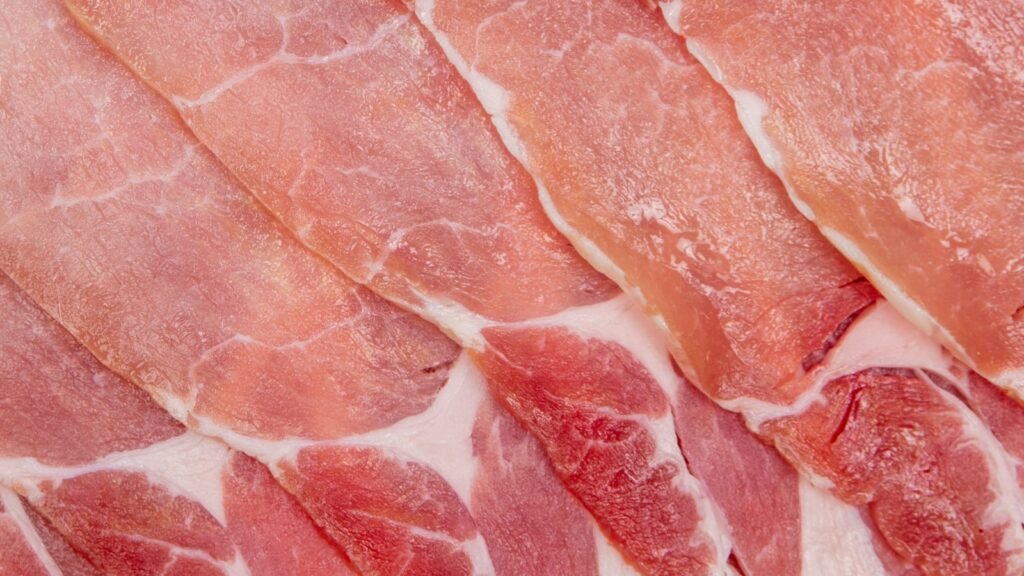
In processed meat, carrageenan has one main job: holding water inside the product through cooking, chilling and slicing. Done well, that gives a juicier bite, cleaner slices and less liquid in the pack. Kappa carrageenan, extracted mainly from cottonii seaweed, is the type most used, and meat processing is one of its major applications. For seaweed buyers and suppliers, it is also an application where inconsistent raw material shows up quickly on the production line.
What carrageenan does in meat
Meat naturally holds water through its proteins, helped by salt and, in many products, phosphates. During cooking, some of that water is lost. Carrageenan supports the meat’s own water-holding in a different way: it dissolves when the product is heated, then forms a gel as the product cools, trapping water in the spaces between muscle fibres.
The practical effects that processors look for are:
- Water retention: less cooking loss and less liquid purge in the pack during shelf life.
- Texture: firmer, more cohesive slices that hold together on a slicer.
- Succulence: retained water contributes to a moister eating quality.
- Binding: in products made from pieces of meat, carrageenan helps the pieces hold together.
Kappa is favoured because it forms firm gels in the presence of potassium and works with the salts already present in meat brines. Iota is used less often, sometimes in blends. The three types are introduced in our explainer on kappa, iota and lambda carrageenan.
How it gets into the meat: brine injection
For whole-muscle products such as cooked ham or turkey breast, carrageenan is usually added through the brine. The broad sequence is:
- Preparing the brine. Carrageenan is dispersed in cold brine together with salt and other ingredients. In the salty, cold liquid it stays largely undissolved as fine particles, which keeps the brine thin enough to inject.
- Injection. Needles distribute the brine through the muscle.
- Tumbling or massaging. Mechanical action helps spread the brine evenly and extracts proteins that aid binding.
- Cooking. Heat dissolves the carrageenan within the meat.
- Cooling. The carrageenan gels as the product cools, holding the added water in place.
In minced and emulsified products such as sausages, carrageenan can be added directly to the mix, often alongside starches and proteins. It is also used in reduced-fat products, where water and a gel partly replace fat.
Semi-refined or refined?
Both semi-refined carrageenan (listed as E407a, processed Eucheuma seaweed) and refined carrageenan (E407) are used in meat. Semi-refined grades are common in many meat applications, where the slight cloudiness from retained plant material does not matter. Refined grades are chosen where clarity or specific performance is needed. Our article on semi-refined versus refined carrageenan explains how each route uses the raw seaweed.
Why raw material consistency matters
A meat plant runs to tight formulations: a set amount of brine per kilogram of meat, a target cooked yield, a slice that must pass inspection. If the carrageenan’s gel strength varies, the yield and texture of the product vary too. Carrageenan producers manage this by testing and blending extracts to a standard, but that is easier and cheaper when the seaweed arriving at the factory is consistent in species, cleanliness, moisture and age. Useful yield indicators such as clean anhydrous weed help processors judge this at purchase.
Frequently asked questions
Is carrageenan used to add water to meat?
It holds water that is part of the formulation, such as brine. Labelling rules in most markets require added water and ingredients to be declared, and some regulations limit how much can be added in certain products.
Why not just use more phosphate or salt?
Salt and phosphate help meat proteins hold water, but there are limits for taste, health and regulation. Carrageenan works through a different mechanism, so it complements them rather than replacing them.
Does carrageenan change the flavour of meat?
At the levels used in meat products it is not expected to add flavour. Its effect is on texture, juiciness and yield.
Working with Kospermindo
Kospermindo aggregates seaweed supply from organised farmer groups in South and Central Sulawesi and has long-term partnerships with processing factories and exporters. See our products and trade page.