
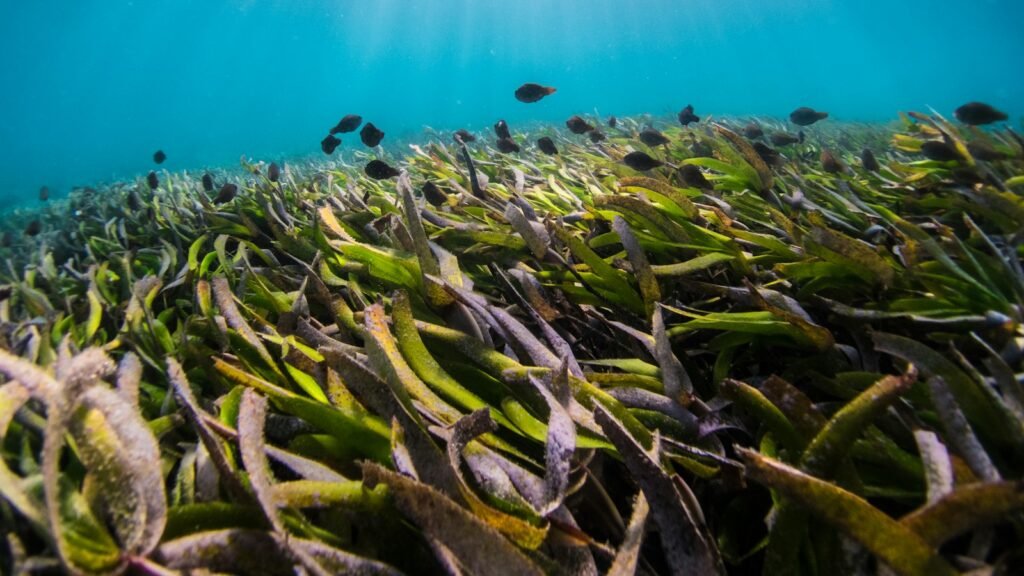
In seaweed farming, the “seed” is not a seed at all. Cottonii and spinosum are grown from cuttings: pieces of the previous crop tied back on to the lines. That makes planting material the single most important input a farmer controls. Healthy cuttings grow quickly and resist stress; weak or infected ones carry their problems straight into the next harvest, and the one after that.
How Vegetative Propagation Works
Farmed red seaweeds can reproduce sexually in the wild, but farms rely almost entirely on vegetative propagation. A farmer cuts branches from a healthy plant, ties them to a planting rope and lets them grow until harvest. Part of the harvest is then kept back to plant the next cycle.
This is simple, cheap and fast, and it lets farmers keep a strain they know performs well. It also means that every plant on a farm may be a clone of the same original stock, repeated over many years. Any weakness in that stock is copied along with it. For a picture of how tying and planting fit into the working week, see A Day on a Seaweed Farm.
Why Seed Stock Degrades
Farmers and researchers in many producing areas report that planting material seems to lose vigour after long periods of repeated cutting and replanting. The causes are not fully understood, and they probably differ between places, but the explanations usually put forward include:
- Carry-over of disease and epiphytes: cuttings taken from a stressed or infected crop can bring bacteria and epiphytic algae with them.
- Selection pressure in the wrong direction: when the best seaweed is sold and what is left over is replanted, the weaker material tends to be multiplied.
- Accumulated stress: repeated exposure to poor conditions, such as high temperatures or low salinity, may leave plants less able to recover.
- Lack of fresh genetic material: with little sexual reproduction on farms, there is limited renewal of the stock.
Research institutions in Indonesia and elsewhere have worked on tissue-cultured and selected strains to supply cleaner planting material. These approaches are promising, but getting such seedlings to large numbers of smallholders, at a price they can afford, remains a practical challenge.
Choosing Good Cuttings
At farm level, the most useful practices are straightforward. Good cuttings are usually:
- Young and actively growing, taken from the branch tips rather than old, thick base material.
- Firm and bright, with the normal colour of the strain and no soft, pale or whitened patches.
- Clean, free of epiphytes, silt and grazing damage.
- Well branched, which gives more growing points once planted.
- Of a consistent size, so that the crop grows evenly and can be harvested together.
Handling and Keeping Seed Stock
Even good cuttings can be damaged between cutting and planting. Seedlings should be kept wet with seawater and shaded from direct sun, packed loosely rather than crushed, and planted as soon as possible. When seedlings are moved between areas, farmers should be aware that they may also be moving disease.
Some farmers and groups keep a dedicated area of lines as a seed nursery, managed for planting material rather than for sale. This makes it easier to select the healthiest plants and avoids the temptation to replant what could not be sold. Timing planting to avoid the most stressful periods of the year also helps; our article on seasons, disease and climate covers the main risks.
What This Means for Buyers
Buyers rarely see seedlings, but they feel the effects. Poor planting material shows up as lower yields, more disease, more variation between harvests and sometimes seaweed harvested early to salvage a failing crop. Supply from farmer groups that invest in seed selection and receive technical support is, in general, steadier. Our page on cottonii cultivation gives more background.
Frequently asked questions
Can seaweed farmers buy certified seedlings?
In some places, seedlings from nurseries or research programmes are available, but most smallholders still rely on their own or neighbours’ stock. Availability varies widely by area.
Does the colour of the seaweed indicate a better strain?
Not on its own. Cottonii strains come in several colours, and colour also changes with light and nutrients. Growth rate, health and carrageenan quality matter more.
How often should farmers renew their seed stock?
There is no fixed rule. A sensible approach is to renew stock whenever growth slows or disease becomes frequent, using the healthiest local material available.
Working with Kospermindo
Kospermindo provides mentoring and technical assistance to farmer groups in South and Central Sulawesi through its Farmer Group Centres. Learn about partnership opportunities.