
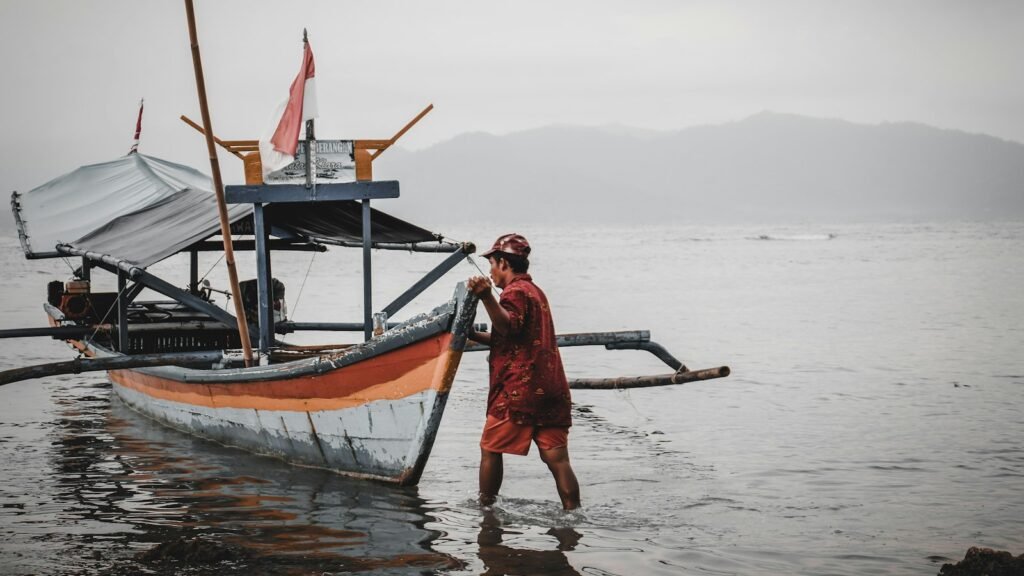
A sack of dried cottonii on a warehouse floor looks like a simple commodity. It is the product of several weeks of manual work by a household that planted, tended, harvested and dried it, usually with no machinery beyond a small boat. Understanding that routine helps buyers see why quality varies, why supply follows the weather and why support for farmers shows up in the quality of what arrives.
The Tide Sets the Timetable
On most smallholder farms the working day is set by the tide and the light rather than by the clock. Farmers using off-bottom systems in shallow water work at low tide, when they can walk or wade among the lines. Those using long-lines in deeper water go out by boat and work from the side or in the water. Our article on long-line versus off-bottom farming explains the two systems.
Morning: Tying Seedlings on Shore
Planting starts on land. Farmers cut healthy pieces from the previous harvest and tie them, one by one, to a long planting rope at regular intervals using short strands of raffia or plastic tie. A single rope carries many seedlings, and a farm has many ropes, so this is slow, repetitive work. In many households it is shared among family members, and it is often done by women and older relatives while others are out on the water.
The choice of cuttings matters. Pieces that are young, firm and free of disease grow faster and give a better crop, which is why good planting material is worth protecting.
On the Water: Tending the Lines
Once planted, the ropes are carried out and tied between stakes or anchored floats. For the following weeks the work is maintenance:
- Checking that stakes, anchors and floats are holding, especially after rough weather.
- Shaking or wiping off silt, and picking off epiphytes and other algae that compete for light.
- Removing drifting rubbish and plastic that tangles in the lines.
- Replacing seedlings that have broken off or been grazed by fish.
- Watching for pale, softening branches, the first signs of stress or disease.
Most of this is done by hand, and a farmer may be in the water for hours. Weather decides a lot: strong waves can snap lines, heavy rain can lower the salinity of shallow water and hot, still spells can stress the crop. We discuss these risks in seasons, disease and climate.
Harvest Day and the Long Drying
When the seaweed has grown enough, usually after several weeks, the whole rope is untied and brought ashore by boat or carried in baskets. The work then follows a familiar sequence:
- Stripping the seaweed from the rope and setting aside good pieces as seedlings for the next cycle.
- Spreading the harvest on raised racks, nets or tarpaulins, ideally away from sand.
- Turning it by hand so that it dries evenly in the sun and wind.
- Gathering it up or covering it quickly when rain comes, then spreading it out again.
- Picking out ties, rope ends and other debris, then packing the dry seaweed into sacks.
Drying typically takes several days of good weather and a great deal of attention. It is the stage that most affects moisture, cleanliness and price, as explained in why drying decides the price of dried seaweed. It is also why protected drying structures, such as UV-plastic drying houses, attract interest: they let farmers keep drying through showers.
Why the Routine Matters to Buyers
Almost every quality parameter a processor measures, from moisture and salt to foreign matter and harvest age, is shaped by decisions made during this routine. A farmer who needs cash quickly may harvest early; one without a covered space may lose a batch to rain. Organised farmer groups, fair and prompt payment, and practical training help farmers make better choices. The social side of this is discussed in our article on social impact and cooperatives.
Frequently asked questions
How many people does a small seaweed farm need?
It varies widely. Many farms are run by a household, with extra help from relatives or neighbours at planting and harvest, when the workload peaks.
Is seaweed farming full-time work?
For some families it is the main livelihood; for others it sits alongside fishing, trading or other jobs. The daily workload rises sharply around planting, harvest and drying.
Does seaweed farming need inputs such as feed?
No. Seaweed farming needs no feed, fertiliser or freshwater. The main costs are ropes, ties, stakes or floats, boats and labour.
Working with Kospermindo
Kospermindo has supported seaweed farmer groups in South and Central Sulawesi since 2002 through Farmer Group Centres offering mentoring, technical assistance and a cooperative savings and loan service. In 2026 it signed a cooperation agreement as a winner of the Madaya Sustainable Fund for a UV-plastic smart drying house programme. Read our history.