
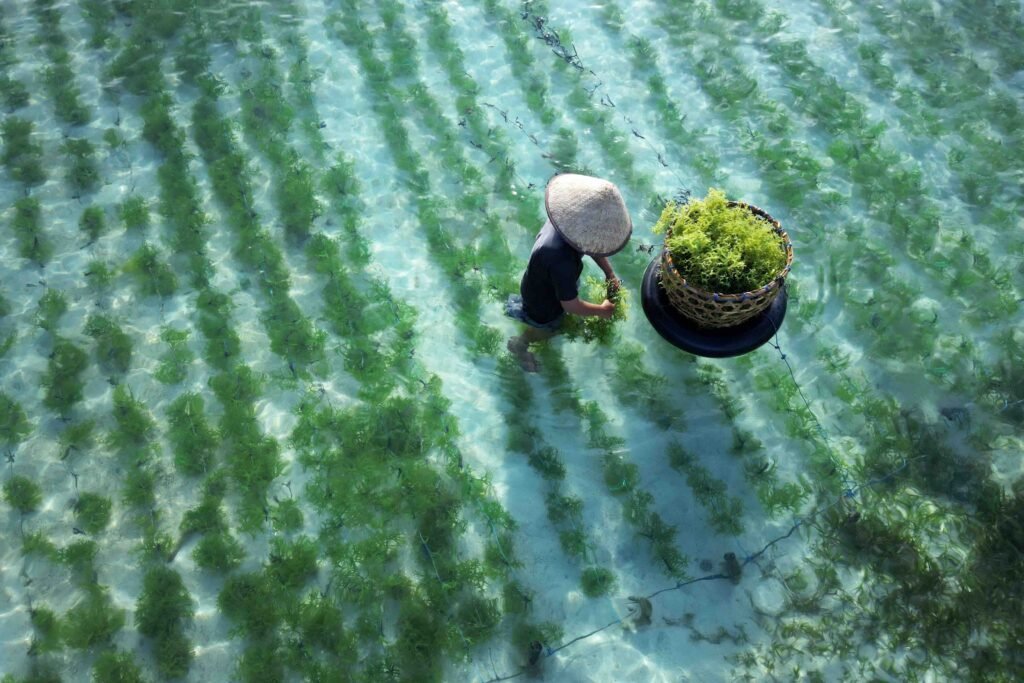
Buyers see seaweed as dried material in sacks. Investors see it as a line in a trade statistic. Behind both is a farming system that is simple, low-cost and remarkably productive — and understanding it explains a great deal about quality, supply and risk.
How a seaweed farm works
Tropical red seaweed such as cottonii is grown from cuttings. Farmers tie small pieces of healthy seaweed from a previous harvest to ropes in the sea, leave them to grow for several weeks, then harvest — keeping back some of the crop as the next round of seedlings. The farm needs no feed and no fertiliser: the plants grow on sunlight and nutrients in the water.
The long-line method
In the long-line method, long ropes are stretched between anchors in the water and kept near the surface with floats — often recycled plastic bottles. Seedlings are tied along each rope at regular intervals.
- Where it works: sheltered water deeper than a person can stand in, so farms can extend further from shore.
- Strengths: plants stay near the surface where light is best, and away from grazing animals and sediment on the seabed.
- Trade-offs: more rope and floats to buy and maintain, and exposure to storms and strong currents.
The off-bottom method
In the off-bottom method, ropes are tied between wooden stakes driven into a shallow sandy or reef-flat seabed, keeping the seaweed just above the bottom.
- Where it works: shallow, sheltered intertidal areas that can be reached on foot at low tide.
- Strengths: low cost and easy to tend.
- Trade-offs: limited to shallow sites, more exposure to heat at low tide, grazing fish and sediment.
What this means for buyers and investors
- Supply is spread across many small farms. Consistency depends on how well those farms are organised, not on any single site.
- Inputs are cheap, but not free. Rope, floats and seedlings are where small loans make a big difference.
- Materials matter for sustainability. Plastic floats and ropes need managing so they do not end up as marine debris.
- Seedling quality drives yield. Healthy, well-selected cuttings are the cheapest productivity gain available.
Frequently asked questions
How long until seaweed can be harvested?
Tropical red seaweed such as cottonii is typically harvested after around six to seven weeks of growth, although timing varies with the site and season.
Where do seedlings come from?
Mostly from the farmer’s own previous harvest: healthy pieces are kept back and tied to the lines as the next crop. Better seedling selection is one of the cheapest ways to improve yields.
Which method produces better quality?
Neither is better everywhere. Long-line suits deeper, sheltered water; off-bottom suits shallow flats. Quality depends more on seedlings, site conditions and post-harvest handling than on the method alone.
Where cooperatives fit
A single farmer chooses a method based on the water in front of the house. A cooperative can do more: share good seedlings, finance equipment, train members in better practice and set drying standards across many farms. That is what turns thousands of small plots into a supply a buyer can plan around — see our buyer’s guide to sourcing cottonii.
Kospermindo — Koperasi Serikat Pekerja Merdeka Indonesia — has supported seaweed farmer groups in South and Central Sulawesi since 2002. Contact us to visit the farms behind the supply.