
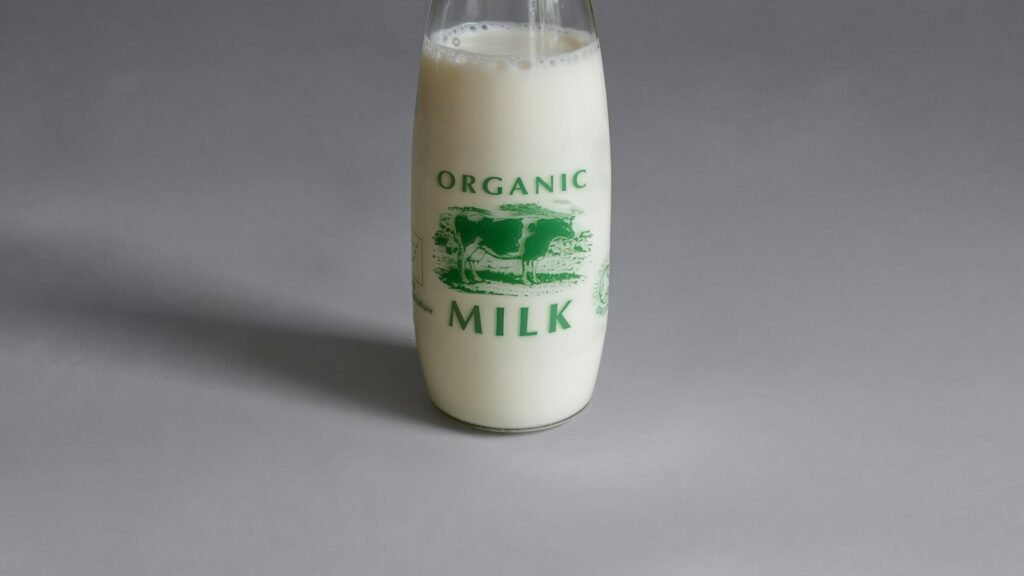
Dairy is one of the oldest and largest uses of carrageenan, and the reason is chemistry rather than habit. Kappa carrageenan interacts with milk proteins in a way few other thickeners do, which means very small amounts can hold cocoa in suspension, stop whey separating from ice cream or keep cream stable. It is usually one component of a stabiliser system rather than a stand-alone ingredient, chosen and dosed by the supplier or the dairy’s own technologists. For anyone buying the red seaweed behind it, dairy is a good example of why raw material consistency matters.
Why milk and kappa carrageenan work together
Milk contains casein proteins organised in tiny particles called micelles. On the surface of those micelles sits kappa-casein, which carries a positive charge in one region. Kappa carrageenan is negatively charged and binds to it. At the same time, carrageenan molecules link with one another. The result is a weak, invisible network running through the milk that supports particles and fat droplets without making the drink feel set.
This “milk reactivity” is strongest for kappa carrageenan, which comes mainly from cottonii (Kappaphycus alvarezii). Iota carrageenan, from spinosum, gives softer, more elastic textures, while lambda does not gel and is used to add body. Our guides to the three carrageenan types and to cottonii and spinosum explain the background.
Where it is used, product by product
Chocolate milk
Cocoa particles are heavier than milk and settle to the bottom of the bottle. A low level of carrageenan forms just enough of a network to keep them suspended, so the drink stays uniform without shaking. Too little and cocoa settles; too much and the drink becomes noticeably thick.
Ice cream
Ice cream stabilisers are usually blends. Gums such as locust bean gum or guar control ice crystal growth and melt behaviour, and they can make the milk proteins separate from the mix, a defect called wheying-off. A small addition of carrageenan counters that separation. The blend as a whole also helps the ice cream withstand the temperature swings of distribution.
Cream and dairy desserts
In whipping cream, carrageenan helps stabilise the foam and reduce liquid separation. In heat-treated creams it helps keep the product uniform through its shelf life. In set desserts and flans, kappa and iota carrageenan provide the gel, often at levels chosen to give a particular spoonable texture.
What formulators and buyers should consider
- Type and blend: most dairy products use a standardised blend rather than raw carrageenan of one type. The seaweed source affects what blending is needed.
- Refined or semi-refined: refined carrageenan (E407) gives clear, clean results; processed Eucheuma seaweed (E407a) contains more cellulose and suits products where slight cloudiness is acceptable. See semi-refined vs refined.
- Consistency: because dosing is low, small variations in gel strength show up in the product. That puts a premium on consistent raw seaweed, specified as set out in our guide to reading a specification sheet.
- Processing conditions: heat treatment, pH, calcium and other salts all affect how carrageenan behaves, so a stabiliser that works in a pasteurised drink may need adjusting for a UHT product.
- Regulation: permitted uses and limits differ by country and by product category, with stricter rules for infant formula.
Frequently asked questions
Is carrageenan in milk drinks safe?
Food-grade carrageenan is an approved additive in major markets, and regulators have reviewed it several times. It should not be confused with degraded carrageenan (poligeenan), a different low-molecular-weight material that is not permitted in food. Debate continues in some quarters, and buyers should follow their own regulator’s current position.
Can other thickeners replace carrageenan in dairy?
Some can in particular products, often in combination, but few match kappa carrageenan’s interaction with milk protein at such low levels. Replacements can change texture, stability or cost.
Why does chocolate milk need only a little carrageenan?
Because the interaction with milk protein is very efficient. The network needed to hold cocoa is weak, so a small amount is enough, and more would make the drink thicker than consumers expect.
Working with Kospermindo
Kospermindo aggregates red seaweed from organised farmer groups in South and Central Sulawesi for processors and exporters. See our products and trade page.