
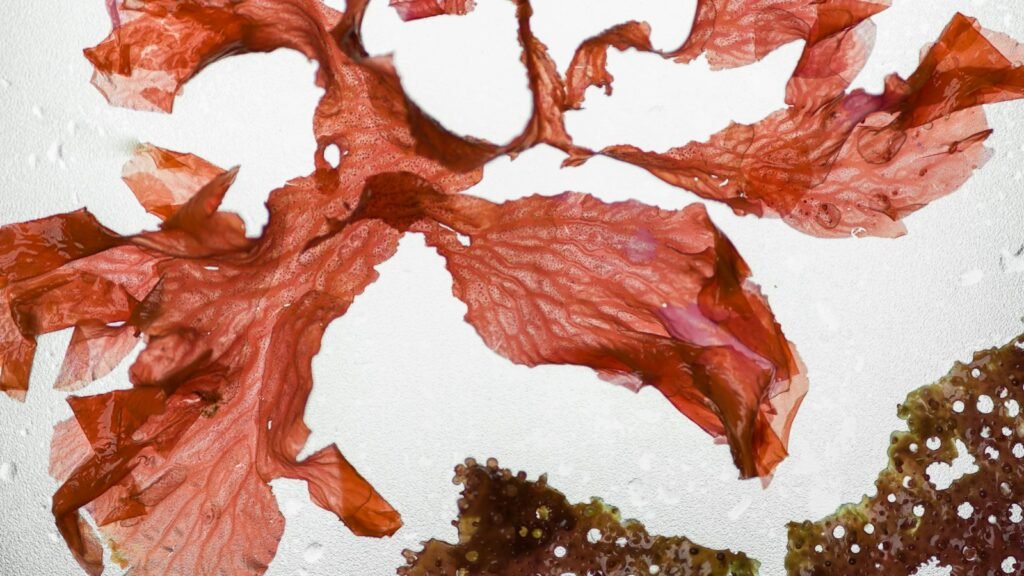
Most of the carrageenan in the world’s food and personal-care products starts as one of two farmed red seaweeds: Kappaphycus alvarezii, traded as cottonii, and Eucheuma denticulatum, traded as spinosum. They are grown in similar tropical waters, often by the same farmers, but they are not interchangeable. Cottonii is the source of kappa carrageenan; spinosum is the source of iota. A buyer who confuses the two, or who receives a mixed lot, ends up with the wrong raw material for the product it wants to make.
How to Tell Them Apart
Dried, baled and sacked, both seaweeds can look like tangles of dark, salty strands. Fresh or rehydrated, the differences are clearer:
- Cottonii (Kappaphycus alvarezii): thick, fleshy, fairly smooth branches that can be green, brown, red or yellowish depending on the strain and growing conditions. The trade names “cottonii” and “Eucheuma cottonii” are historical and still widely used.
- Spinosum (Eucheuma denticulatum): thinner branches covered with small spine-like projections arranged around the stem, which is where the trade name comes from. It usually feels rougher and more wiry in the hand.
- After drying: colour and texture become less reliable guides. Experienced graders look at branch thickness, the spines and how the material breaks, but a laboratory test on the extracted carrageenan is the only definitive check.
Kappa Versus Iota: What the Difference Means in a Gel
The two seaweeds produce different kinds of carrageenan because their cell walls are built from slightly different sugar chains. In practice, the difference shows up in how the extracted carrageenan behaves once it is dissolved and cooled.
Kappa carrageenan from cottonii forms firm, fairly brittle gels, especially in the presence of potassium. It reacts strongly with milk proteins, which is why it is widely used in dairy. Kappa gels can weep water over time, a behaviour known as syneresis, and they do not usually survive freezing and thawing well.
Iota carrageenan from spinosum forms softer, elastic gels, especially with calcium. These gels tend to recover after being broken and hold up better through freeze–thaw cycles. Many formulators blend the two types, along with other hydrocolloids, to get a particular texture.
For a broader comparison with other seaweed gums, see our article on carrageenan versus agar.
Where Each Ends Up
Cottonii is the larger of the two trades and feeds both refined and semi-refined carrageenan production. Typical end uses for kappa include processed meat, dairy products such as flavoured milks and desserts, water-based jellies and pet food. Spinosum is traded in smaller quantities and is mainly processed into refined iota carrageenan for dairy desserts, some sauces and dressings, toothpaste and cosmetic creams, where its softer, more elastic texture is wanted.
Indonesia is one of the world’s largest producers of tropical red seaweed, and cottonii is the main species grown by smallholders along much of the Sulawesi coast. Our page on cottonii cultivation explains how it is farmed.
How Buyers Specify Them
A clear specification avoids most disputes. For either seaweed, a purchase contract or enquiry usually covers:
- Species and trade name, written out in full, with a statement that the lot is not mixed with other species.
- Origin, down to the province or growing area where possible.
- Maximum moisture content, because dried seaweed still holds water that the buyer pays for by weight.
- Cleanliness, including limits on sand, salt, rope fragments and other foreign matter.
- Yield or performance indicators agreed with the processor, such as clean anhydrous weed or gel strength, and the test method used.
- Packing and lot identification, so that each sack can be linked to the records behind it.
Our buyer’s guide to sourcing cottonii covers the commercial side in more detail.
Frequently asked questions
Is “Eucheuma cottonii” the same as Kappaphycus alvarezii?
In the trade, yes. The seaweed was reclassified into the genus Kappaphycus, but “Eucheuma cottonii” and “cottonii” remain the common commercial names for the kappa-bearing seaweed.
Can cottonii and spinosum be mixed in one shipment?
They should not be, unless the buyer has asked for it. Because they give different carrageenan types, a mixed lot changes the processor’s yield and gel properties, and it is usually treated as a quality defect.
Does one seaweed produce lambda carrageenan?
Lambda carrageenan is not the main product of either farmed seaweed. It is associated with other red seaweeds and certain life stages, and it does not form gels; it is used mainly as a thickener.
Working with Kospermindo
Kospermindo, a cooperative based in Makassar, has supported seaweed farmer groups in South and Central Sulawesi since 2002 and works in long-term partnerships with processors and exporters. See our trade page or contact us to discuss your specification.