
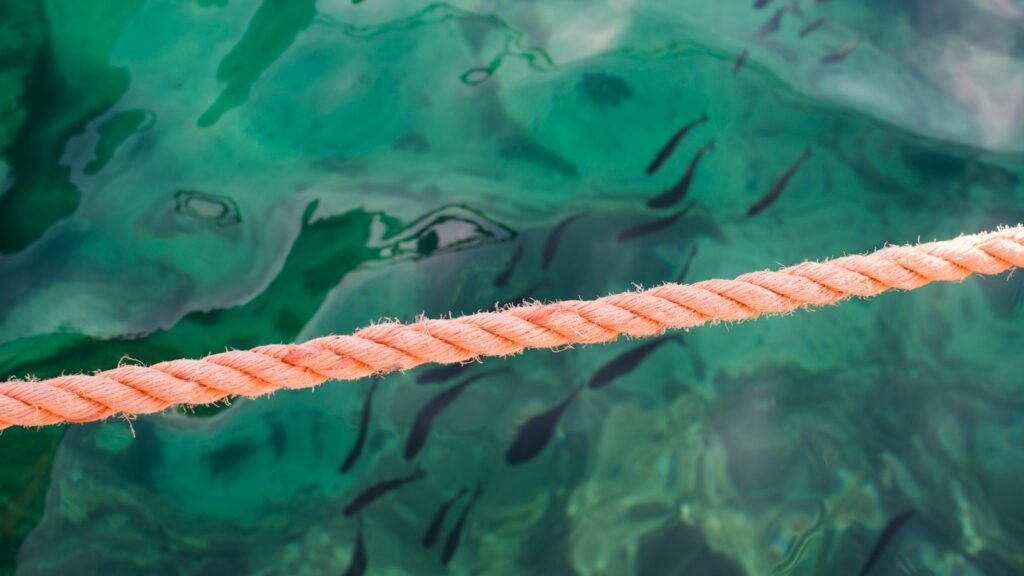
A tropical seaweed farm looks simple from the shore: rows of floats or stakes, and lines of seaweed between them. Behind that simplicity are choices about materials that decide how much a farm costs to set up, how well it survives rough weather, how much work it takes to maintain, and how much plastic ends up on the beach. This post walks through the parts of the two common systems and the practices that keep them working.
Two systems, different materials
Most red seaweed in Sulawesi is grown either on long-lines in deeper water or on off-bottom lines in shallow reef flats and lagoons. We compare them in detail in long-line versus off-bottom farming. Here the focus is on what each is made of.
Long-line farms float at or near the surface. Their main parts are:
- Anchors: weights, blocks or stakes driven into the seabed that hold each end of the main line in place against current and waves.
- Main and planting ropes: a heavier frame rope with lighter planting lines running along or between it, to which seedlings are tied.
- Floats: purpose-made buoys or, very often, recycled plastic bottles and jerrycans that keep the lines near the surface where there is light.
- Ties: short lengths of raffia or soft string used to attach each seedling cutting to the planting line.
Off-bottom farms sit in shallow water that may nearly dry at low tide. Wooden or bamboo stakes are driven into the sand in rows, and planting lines are stretched between them a little above the seabed. They need fewer floats and anchors, but they depend on suitable ground and are exposed to grazing fish, sediment and heat in very shallow water.
Keeping a farm in working order
Farm materials take a beating from sun, salt, waves and fouling organisms. Regular maintenance is part of every cycle:
- Check anchors and stakes after storms and before planting, since a single failed anchor can drag a whole line into its neighbours.
- Clean lines of fouling, epiphytes and tangled debris, which compete with the crop and add weight.
- Replace worn rope before it parts, rather than after, and keep spare lines ready for the busy planting period.
- Adjust depth and tension as conditions change, for example lowering lines in hot, calm weather when surface water may stress the plants.
- Record what was replaced, so the group can budget for materials and see which parts fail most often.
The cost of rope, floats and replacement parts is one of the main expenses farmers carry from cycle to cycle, discussed further in the economics of a farming cycle.
Plastic waste and good practice
Almost every part of a modern seaweed farm is plastic: polypropylene or polyethylene rope, plastic floats and bottles, and raffia ties. Lines break in storms, ties are cut at harvest and dropped in the water, and old floats are abandoned when farms move. Over time this becomes a real source of marine litter on the coasts where seaweed is grown.
Good practice is mostly a matter of habit and organisation rather than new technology:
- Collect cut ties at harvest instead of dropping them overboard, and bring them ashore for disposal.
- Use durable floats and ropes that last several cycles, rather than the cheapest option that fails quickly.
- Mark and remove abandoned lines and stakes when a plot is no longer farmed.
- Agree group rules on waste, with a shared collection point on land.
Buyers increasingly ask about environmental practice at farm level. A group that can show how it handles farm waste has a better answer than one that cannot. Our post on seaweed as a low-input crop puts this in context.
Frequently asked questions
Why do so many farms use plastic bottles as floats?
They are cheap, available in villages and do the job. Their drawback is that they break down in the sun and are easily lost, so purpose-made floats can be a better long-term choice where farmers can afford them.
Are there alternatives to plastic rope?
Natural fibre ropes have been tried, but they tend to rot quickly in warm seawater. Most farms still use synthetic rope; the practical focus is on making it last and bringing it back to land at the end of its life.
Does the farm system affect seaweed quality?
Indirectly. Water depth, movement and exposure influence growth and stress, and off-bottom farms may pick up more sand. Drying and handling after harvest usually matter more to the final quality of dried seaweed.
Working with Kospermindo
Kospermindo’s Farmer Group Centres offer seaweed farmers in South and Central Sulawesi mentoring, technical assistance and a cooperative savings and loan service. Read more about cottonii cultivation.