
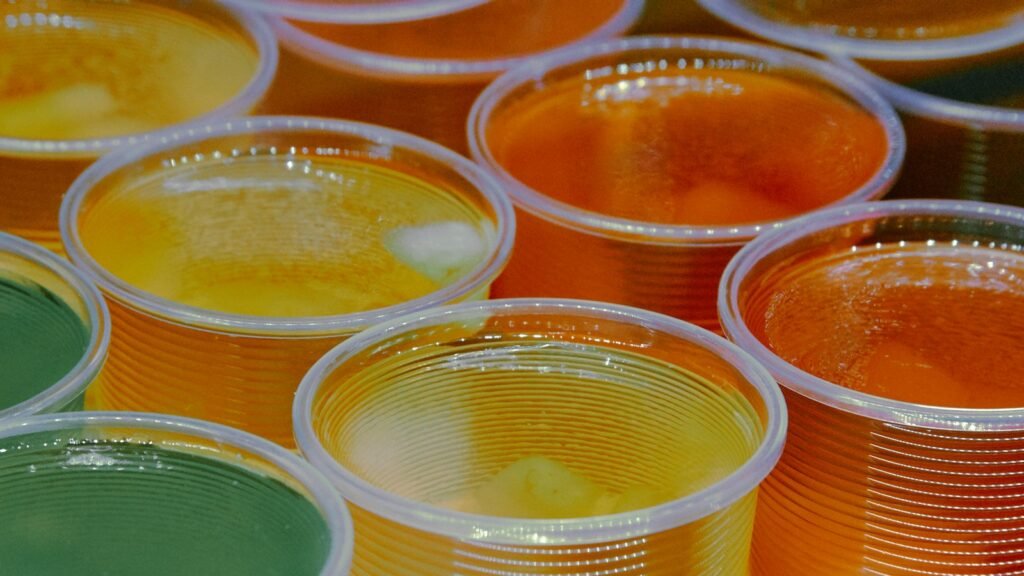
Jelly drinks, cup jellies and beverages with suspended pieces are among the most visible everyday uses of seaweed hydrocolloids. Across much of Asia they are ordinary supermarket and convenience-store products, and they are increasingly found in export ranges and plant-based menus elsewhere. Almost all of them depend on carrageenan, agar or a blend of the two, which ties a simple snack directly back to seaweed farms.
The main product types
- Drinkable jellies: soft gels sold in spouted pouches or bottles, designed to break up when squeezed or shaken. They need a gel that is weak enough to flow through a spout but firm enough to feel like jelly.
- Cup jellies and desserts: set gels in sealed cups, often with fruit pieces. Firmness, clarity and resistance to weeping (water separating from the gel) matter most.
- Beverages with suspended pieces: drinks carrying jelly cubes, fruit cells, seeds or chewy pieces. A small amount of hydrocolloid can keep particles evenly distributed rather than sinking.
- Traditional jellies: in Indonesia, agar-based desserts and home-made jellies have long been part of daily food, as described in our piece on seaweed on the Indonesian table.
Nata de coco, which often appears alongside jelly in these products, is a different ingredient: it is made by bacterial fermentation of coconut water, not from seaweed. Products labelled “nata-like” or “jelly cubes” may use carrageenan or agar to imitate a similar chewy texture.
What carrageenan and agar each contribute
The two gums behave differently, and formulators choose between them, or blend them, according to the texture they want. Our explainers on carrageenan types and how agar is made give the background.
- Kappa carrageenan forms firm, somewhat brittle gels, especially in the presence of potassium. It is widely used in cup jellies, often combined with locust bean gum or konjac to reduce brittleness and weeping.
- Iota carrageenan gives softer, more elastic gels that can recover after being broken, which suits drinkable textures.
- Agar sets firmly at low concentrations and holds its shape at warm temperatures, so it is useful where a product must stay set outside a refrigerator. Its gels are firm but can release water over time.
Because these products are labelled, the ingredient declaration matters too. Carrageenan is declared as E407 or E407a in markets that use E numbers, and agar as E406. Both are suitable for vegetarian and vegan products, which is one reason they are replacing gelatin in many jelly lines, as discussed in gelling without gelatin.
Why raw seaweed quality reaches the shelf
A jelly drink contains only a small amount of hydrocolloid, but its texture depends heavily on that ingredient behaving the same way in every batch. Manufacturers therefore specify gel strength, viscosity, clarity and microbiological limits tightly. Those properties are influenced upstream by the species, the maturity of the crop at harvest, how it was dried and how long it was stored. A processor supplying the drinks industry will look for raw material that is consistent from lot to lot, clean, and traceable to a known origin.
Formulation points buyers often discuss
- Acid stability: fruit drinks are acidic, and carrageenan can lose strength if heated for long periods at low pH, so the order of processing steps matters.
- Heat treatment: pasteurisation or hot filling must be compatible with the gel’s setting and melting behaviour.
- Syneresis: weeping during storage is a common complaint and is usually addressed by blending gums.
- Choking-risk regulations: some markets regulate the size and firmness of small cup jellies, so the texture must meet local rules as well as consumer taste.
Frequently asked questions
Are seaweed jelly drinks a source of fibre?
Carrageenan and agar are indigestible polysaccharides and are counted as fibre in some labelling systems, but the amounts used in drinks are small. Any nutrition claim should be based on the finished product’s analysis and local labelling rules.
Which is better for jelly drinks, carrageenan or agar?
Neither is better in general. Iota carrageenan or blends suit soft, drinkable textures; kappa blends suit set cup jellies; agar suits products that must stay firm at warmer temperatures. Most manufacturers test several options.
Does the seaweed species appear on the label?
Usually not. The label shows the additive name or E number. Buyers who need origin information, for example for sustainability reporting, should ask the ingredient supplier for it directly.
Working with Kospermindo
Kospermindo aggregates dried seaweed from organised farmer groups in South and Central Sulawesi for processing factories and exporters. To discuss raw material for hydrocolloid production, see our products and trade page.